Agentic AI Isn’t a Feature. It’s a Re‑Platforming — And It Will Decide Who Sets the Tone in 2026
Why the Real Power in Enterprise AI Belongs to the Orchestration Layer
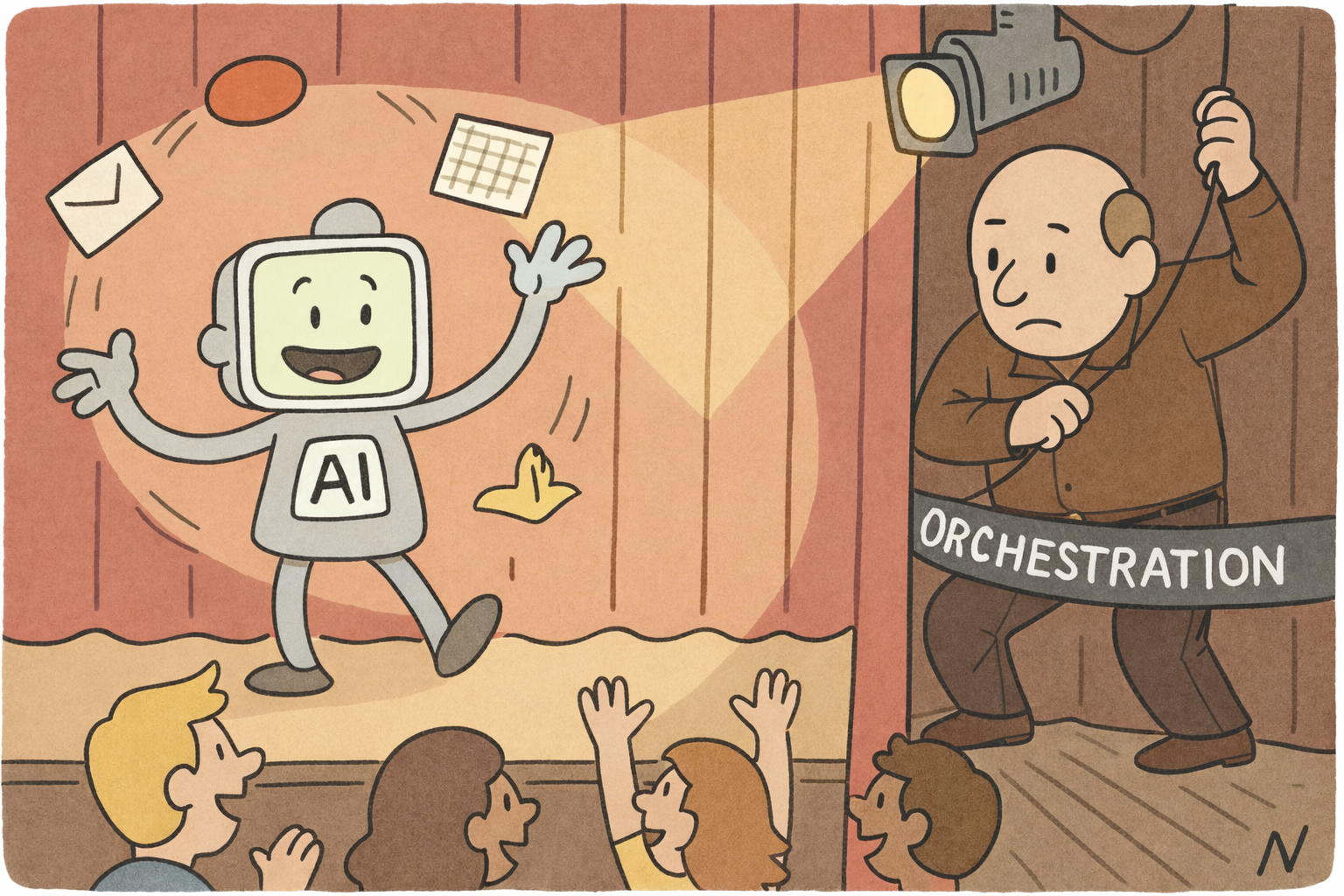
Investors spent the last two years watching companies chase Agentic AI features with urgency and FOMO. But 2026 is shaping up differently. The conversation is shifting from “Who has the best Agentic AI demo?” to “Who has the architecture to actually scale this?”
That shift matters because it changes who wins.
The real question isn’t whether Agentic AI will transform customer experience. It’s which companies have the orchestration foundation to make Agentic AI safe, governable, and enterprise‑ready.
And once you see the difference between Agentic AI features and Agentic AI foundations, the competitive landscape looks very different.
The Wrong Binary
The enterprise narrative has been stuck in a familiar loop:
Delight the customer
Automate the workflow
Modernize the experience
It was comforting to believe that the visible layers were the important ones. But Agentic AI doesn’t live in the visible layers. It lives in the layers beneath — the ones that decide whether autonomy is safe, scalable, and real.
The correct framing isn’t:
“Which matters more?”
It’s:
Businesses care most about the orchestration layer because it enables Agentic AI for every use case — including customer experience.
Agentic CX is exciting. Orchestration is mandatory.
The Hierarchy That Actually Matters
Layer 3 — Applications (CX, CRM, HR, ITSM, etc.) This is where Salesforce shines. This is where end‑users feel the magic. This is where “agentic customer experience” lives.
But it’s the top of the stack — the visible tip of a much deeper architecture.
Layer 2 — Agentic AI (planning, reasoning, acting) This is where CRM is innovating. This is where ServiceNow is trying to evolve. This is where IBM is building tooling.
Agents can plan, reason, and act — but only if the layer beneath them can coordinate, govern, and constrain them.
Layer 1 — Orchestration (the foundation) This is where IBM dominates. This is what enterprises actually need to adopt Agentic AI safely. This is the layer that answers the questions that matter:
Can I control this
Can I audit this
Can I integrate this
Can I trust this
Can I scale this
Without Layer 1, Layers 2 and 3 cannot scale. They cannot be governed. They cannot be trusted.
This is the structural truth enterprises are waking up to.
The People Who Set the Tone in 2026
The tone‑setters of 2026 are not end‑users. They’re not the people clicking through a customer portal or receiving an AI‑generated email.
The tone‑setters are:
CIOs
CTOs
enterprise architects
platform owners
data governance teams
compliance officers
These are the people who decide what gets deployed. These are the people who carry the risk. These are the people who must explain the consequences.
And these people do not care about “agentic customer experience” first.
They care about the substrate — the layer that keeps the system honest.
The Quiet Weight of This Shift
There’s a quiet weight in this shift — a discomfort that comes from seeing the foundation for what it really is.
Because it means the last decade of enterprise transformation was only the preface.
The dashboards, the workflows, the customer journeys — they were important, but they were never the foundation. They were the expression of the foundation.
And now the foundation is changing.
Agentic AI is not a feature. It’s not an add‑on. It’s not a new button in an app.
It’s a re‑platforming.
And the companies that understand this — the ones building the orchestration layer — are the ones shaping the future.
The Future Belongs to the Layer You Can’t See
The irony is almost poetic.
The future of enterprise AI won’t be decided by the systems people touch. It will be decided by the systems that touch everything.
The orchestration layer is where:
trust is built
autonomy is governed
agents collaborate
compliance is enforced
outcomes are guaranteed
It’s the layer that makes Agentic AI real. It’s the layer that makes Agentic AI safe. It’s the layer that makes Agentic AI scale.
And in 2026, enterprises are finally beginning to understand that the real power — the real leverage — lives in the layer beneath the apps.
The layer that holds everything together.