The AI Bottleneck Investors Keep Misdiagnosing
The real limit on AI isn’t compute — it’s capacity.
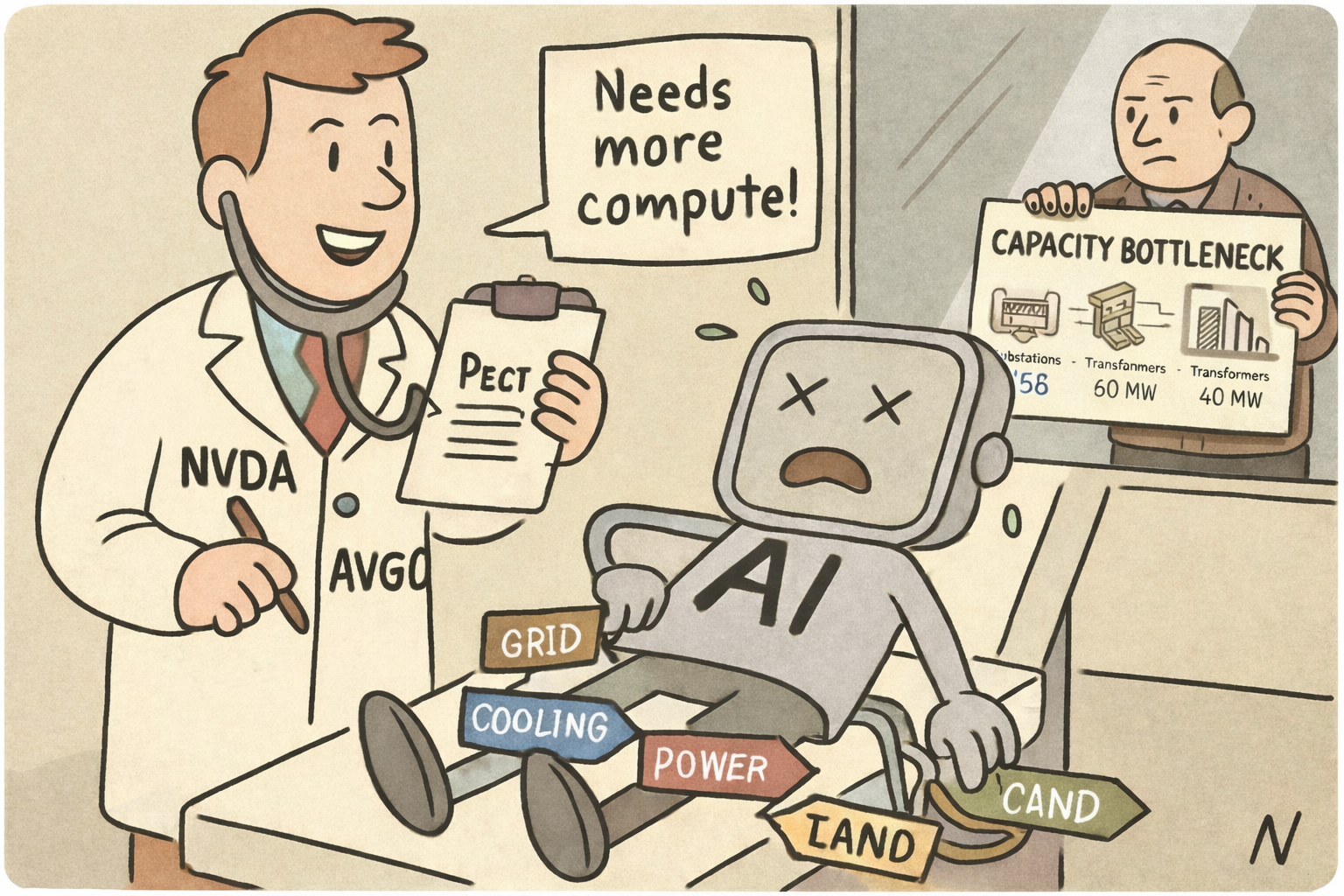
There’s a moment in every AI conversation where someone — usually a CEO — leans back, exhales, and says the same line:
“We need more compute.”
It sounds urgent. It sounds technical. It sounds like a GPU problem.
And for a while, I believed that too.
But the more I mapped the AI pipeline — chips, networking, optics, power, cooling, grid — the more something started to ache. Not because the system was complicated, but because the conversation was incomplete.
We weren’t asking the right question.
The First Bottleneck: The One Everyone Can See
When Jonathan Ross from Groq says “we need more compute,” he’s talking about the bottleneck engineers love:
not enough GPUs
not enough networking throughput
not enough optical bandwidth
not enough accelerators
This bottleneck is fast, visible, and solvable. Throw money at it, and it moves.
This is why investors sprint toward:
NVDA
AVGO
ANET
CIEN / LITE / COHR
It feels like the center of the story because it moves at the speed of ambition.
But that’s not the ache.
The Ache: The Bottleneck That Doesn’t Move
The ache shows up when you zoom out.
Because after you solve the engineering bottleneck, you hit the one that doesn’t bend:
power
cooling
substations
transformers
land
permitting
the grid
This bottleneck doesn’t care about capex or innovation cycles. It doesn’t respond to urgency. It doesn’t scale with demand.
It defines the ceiling of the entire AI ecosystem.
And almost no one wants to talk about it.
Because it’s slow. Because it’s physical. Because it’s regulated. Because it’s inconvenient.
But it’s also the truth.
The Two‑Phase Reality Investors Keep Missing
The AI boom isn’t one bottleneck. It’s two — and they arrive in sequence.
Phase 1 — The Technical Bottleneck → GPUs, networking, optics → fast, exciting, solvable → investors pile in early
Phase 2 — The Physical Bottleneck → power, cooling, grid → slow, structural, immovable → investors arrive late
The ache is that Phase 2 is the one that actually decides how big AI can get — not Phase 1.
But because Phase 1 moves faster, it steals the spotlight.
The Misdiagnosis That Shapes the Market
When CEOs say “we need more compute,” most investors hear:
“Buy more chips.”
But the diagnostic question is:
Is this a performance bottleneck or a capacity bottleneck?
If it’s performance → engineering will fix it.
If it’s capacity → physics and regulation will decide the timeline.
This single distinction explains:
why ANET and AVGO run early
why VRT and utilities run late
why optical networking is exploding
why grid modernization is inevitable
why the AI boom is already hitting its second wall
The ache is realizing that the bottleneck investors obsess over is not the one that defines the future.
The Real Story: The Ceiling Is Not Where People Think It Is
The AI ecosystem won’t be limited by:
GPU supply
networking throughput
optical bandwidth
Those are solvable.
It will be limited by:
megawatts
substations
transformers
cooling
land
regulation
The bottleneck that matters most is the one that moves slowest.
And that’s the part of the story investors still underestimate.
Final Line
If you want to understand where AI is going, stop listening to the bottleneck that screams the loudest. Start listening to the one that refuses to move.