The Customer Thread No One Owns: How KPI Territory Battles Undermine AI in Large Enterprises
Salesforce has built one of the most powerful orchestration platforms in the world. Yet even here, a hidden choke point destabilizes the entire layer: no single owner of the customer thread.
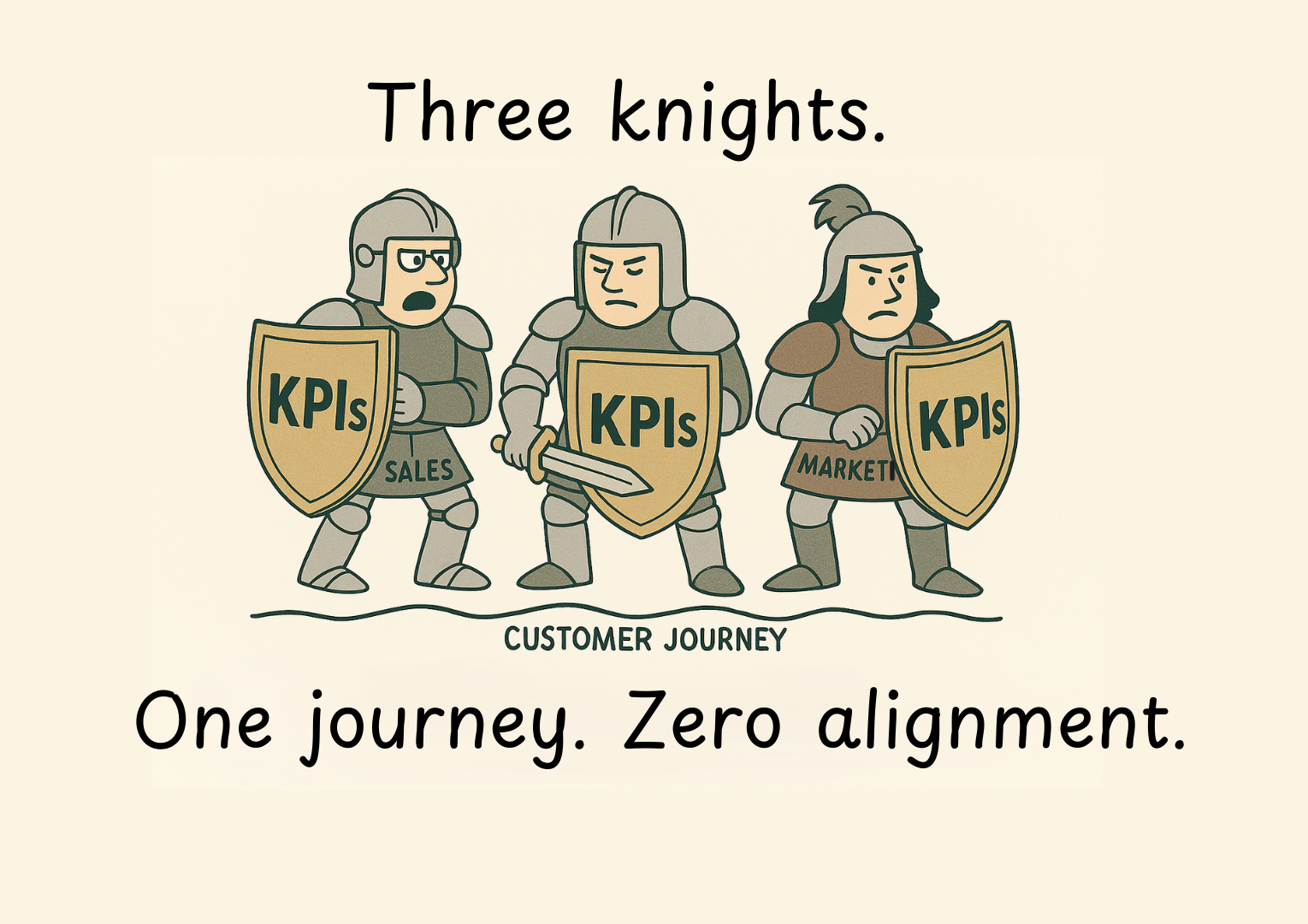
In large enterprises, responsibility jumps between Sales, Service, and Marketing. Each team owns its slice, but no one owns the journey. Continuity collapses at every handoff, governance dissolves, and ROI becomes untraceable. It’s not a minor glitch — it’s the structural flaw that quietly corrupts everything else.
Why Continuity Breaks
The obvious fix is ownership. But ownership is power, and power in companies is tied to KPIs, budgets, and narrative control. Even CEOs struggle to override this resistance.
That’s why AI often gets implemented inside silos, not above them. The fragments get smarter, but the thread stays broken.
“AI was added to the fragments, not to the thread — so the thread is still ownerless.”
The River, Not the Boss
The way forward isn’t to crown a new owner. It’s to introduce a neutral continuity layer — an agent that carries the customer’s context like a river flowing through silos.
It doesn’t take authority away. It simply carries the intent, the commitments, the history — so each team can act with clarity, as if nothing was lost in the handoff.
This framing matters. If AI is positioned as a “boss,” resistance hardens. If it’s positioned as a “river,” each silo sees gain, not loss.
Sales gets cleaner conversions.
Service gets faster resolutions.
Marketing gets sharper targeting.
Everyone wins, no one loses face.
Who Salesforce Could Partner With
A new class of continuity‑focused AI platforms is emerging — tools designed to carry context across silos without threatening KPIs or ownership structures. This platforms design for resistance. They don’t search for blame. They offer stabilizers that make silos look better, not weaker.
Designing for Reality
Fragmentation is structural, not personal. Teams protect their KPIs because that’s how they survive.
The challenge is to build solutions that respect this reality while still fixing the choke point.
For Salesforce, the opportunity is clear: partner with continuity‑focused players who frame AI as a river, not a ruler. Continuity isn’t about ownership. It’s about flow. And flow is what keeps orchestration alive.