The Emergence of Continuity Infrastructure: The Missing AI Layer in Enterprise Architecture
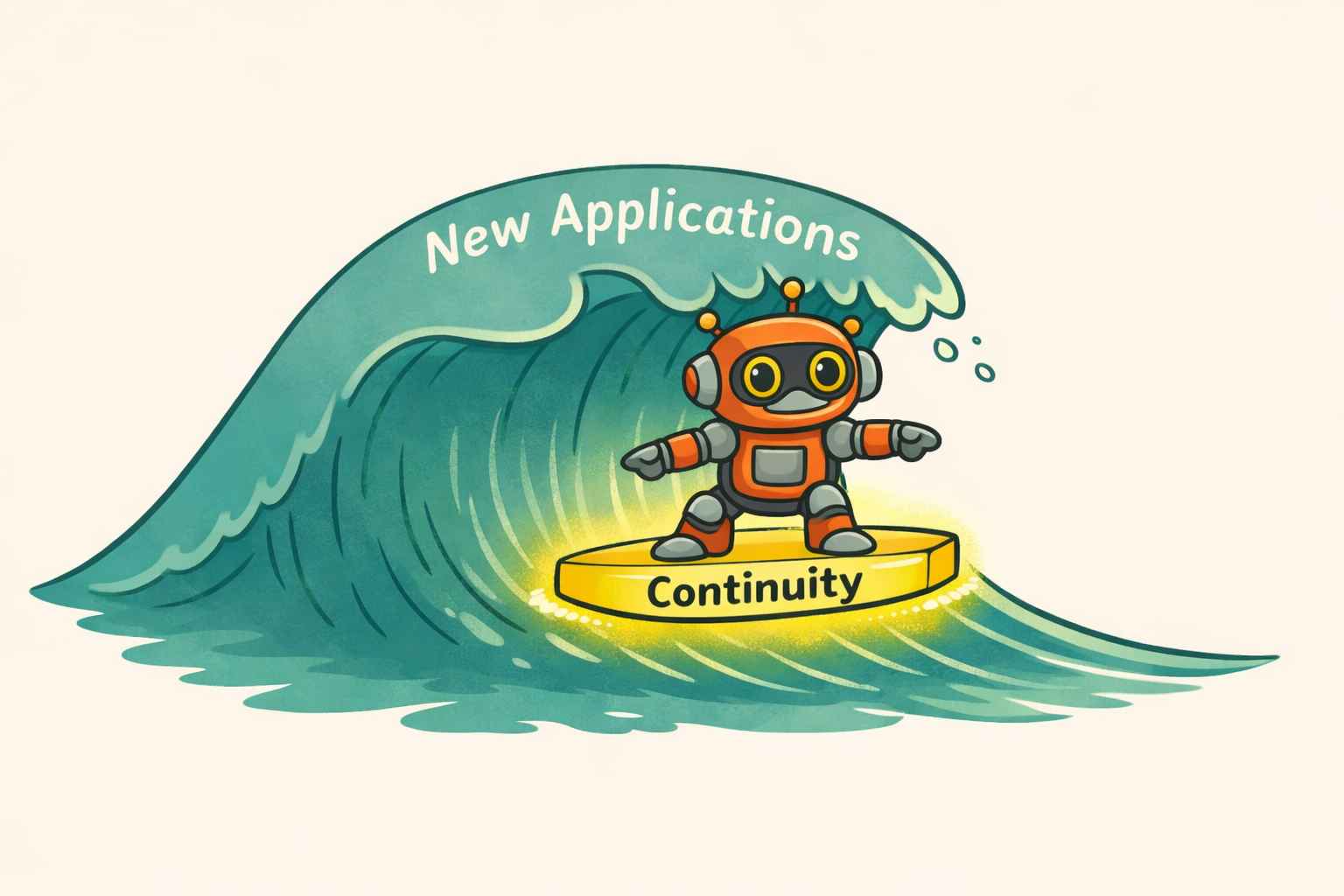
Enterprises are quietly generating a new class of AI systems — not because vendors discovered a breakthrough, but because the architecture forces it. When continuity doesn’t exist, something eventually has to carry it.
That “something” is the new layer forming under the radar: continuity infrastructure.
This is not workflow automation. Not orchestration. Not RAG. Not agents.
It is a structural response to a structural hole.
The Enterprise Problem: Continuity Is Not Modeled Anywhere
Every enterprise claims to care about “the customer journey,” but none of them represent it as a real object. What they actually store are fragments:
Sales → narrative notes
Service → structured fields
Marketing → behavioral events
Operations → system states
These fragments do not align. They do not share a state model. They do not form a thread.
So when enterprises attempt to coordinate across workflows, they aren’t stitching together processes — they’re stitching together incompatible definitions of reality.
This is the root failure mode of enterprise orchestration.
Why AI Makes the Fracture More Visible
AI doesn’t fix fragmentation. It amplifies it.
Agents become smarter inside silos, but the silos themselves remain structurally incompatible. The intelligence improves, but the continuity stays broken.
This is why enterprises keep hitting the same wall:
intent drift
context loss
stale state
contradictory definitions of “resolution”
governance blind spots
unprovable ROI
These are not workflow issues. They are ontology issues.
AI exposes them because AI depends on continuity to reason correctly — and continuity doesn’t exist.
The Architectural Gap: A Missing Layer Between Workflows
The enterprise stack has three visible layers:
Data Layer — stores fragments
Workflow Layer — executes fragments
AI Layer — optimizes fragments
But there is a missing fourth layer:
A continuity layer that preserves context, intent, and state across incompatible workflows.
This layer is not about automation. It is not about replacing humans. It is not about “AI taking over.”
Its job is simpler and more structural:
Carry context across silos without threatening KPIs, ownership structures, or political boundaries.
This is the layer enterprises never built — and now they need it.
Why This Layer Is Emerging Now
Three forces are converging:
Agentic systems require stable context. Agents cannot reason across workflows if the underlying state collapses at every handoff.
Enterprises cannot unify their data models. Silos are not a cultural artifact — they are a survival mechanism tied to KPIs, budgets, and governance.
Orchestration fails without continuity. Even perfect agents cannot coordinate if the thread they depend on does not exist.
The result is inevitable: Enterprises begin adopting systems whose sole purpose is to preserve continuity in environments where continuity doesn’t exist.
This is not a trend. It is a structural necessity.
What Continuity Infrastructure Actually Does
It doesn’t automate workflows. It doesn’t replace teams. It doesn’t challenge ownership.
It performs three stabilizing functions:
Context Preservation Carries the relevant state across workflows, even when the underlying data models disagree.
Intent Stabilization Maintains the user’s purpose across time gaps, channel switches, and workflow transitions.
Cross‑Silo Neutrality Operates above KPIs and political boundaries without threatening them, which is why enterprises tolerate it.
This neutrality is the key. If a system threatens ownership, it dies. If it stabilizes ownership, it survives.
Continuity infrastructure survives.
Why This Is a Category, Not a Product Trend
Most enterprise technology waves are vendor‑driven. This one is architecture‑driven.
Enterprises are not “adopting continuity platforms.” They are creating the conditions that force continuity systems to emerge.
The pattern is consistent:
Fragmentation → increases
AI adoption → accelerates
Orchestration → becomes brittle
Continuity → becomes existential
A new layer → forms to carry what the architecture cannot
This is how categories emerge: Not through marketing, but through necessity.
The Thesis of This Piece
Continuity infrastructure is the missing AI layer in enterprise architecture — a structural response to the fact that continuity is not modeled, not instrumented, and not defined.
It is emerging because enterprises cannot coordinate without it. It is tolerated because it stabilizes silos rather than threatening them. It is necessary because agentic systems cannot function without continuity.
This is the wave worth naming. This is the category worth defining. This is the argument worth writing.