Authority Over Truth Shapes Survivability
We assume enterprises run on truth.
Every dashboard claims it.
Every data warehouse promises it.
Every AI model behaves as if it’s real.
But the deeper you go, the more you see the illusion:
Enterprises don’t run on truth — they run on contradictions that somehow have to coexist.
Conflicting regulated truth.
Conflicting workflow truth.
Conflicting human truth.
Conflicting AI‑computed truth.
Most people inside the enterprise only feel the symptoms — broken workflows, stalled automation, inexplicable model behavior.
But one persona is forced to confront the contradiction directly.
One role must make all these incompatible truths computable at once:
the AI Platform Owner.
They are the first to discover that enterprises don’t break because they’re wrong —
they break because their truths collide.
The Enterprise Doesn’t Break Because It’s Wrong — It Breaks Because Its Truths Collide
Every enterprise runs on overlapping realities:
The regulated system says the patient was discharged.
The workflow system says the case is still open.
The AI model recommends a follow‑up.
The nurse says, “That’s not what actually happened.”
Which one is true?
All of them.
None of them.
It depends on what you’re trying to do.
This is the core of asymmetric authority:
different systems hold different truths, and none can fully dominate.
Pragmatism tells us the goal isn’t to unify these truths —
it’s to make them survivable.
How I Discovered the Real Fracture
To understand why enterprises struggle with truth collisions, I mapped the key stakeholders by impact (how much they suffer when truths diverge) and influence (how much they can shape the resolution).Authority Over Truth Shapes Survivability
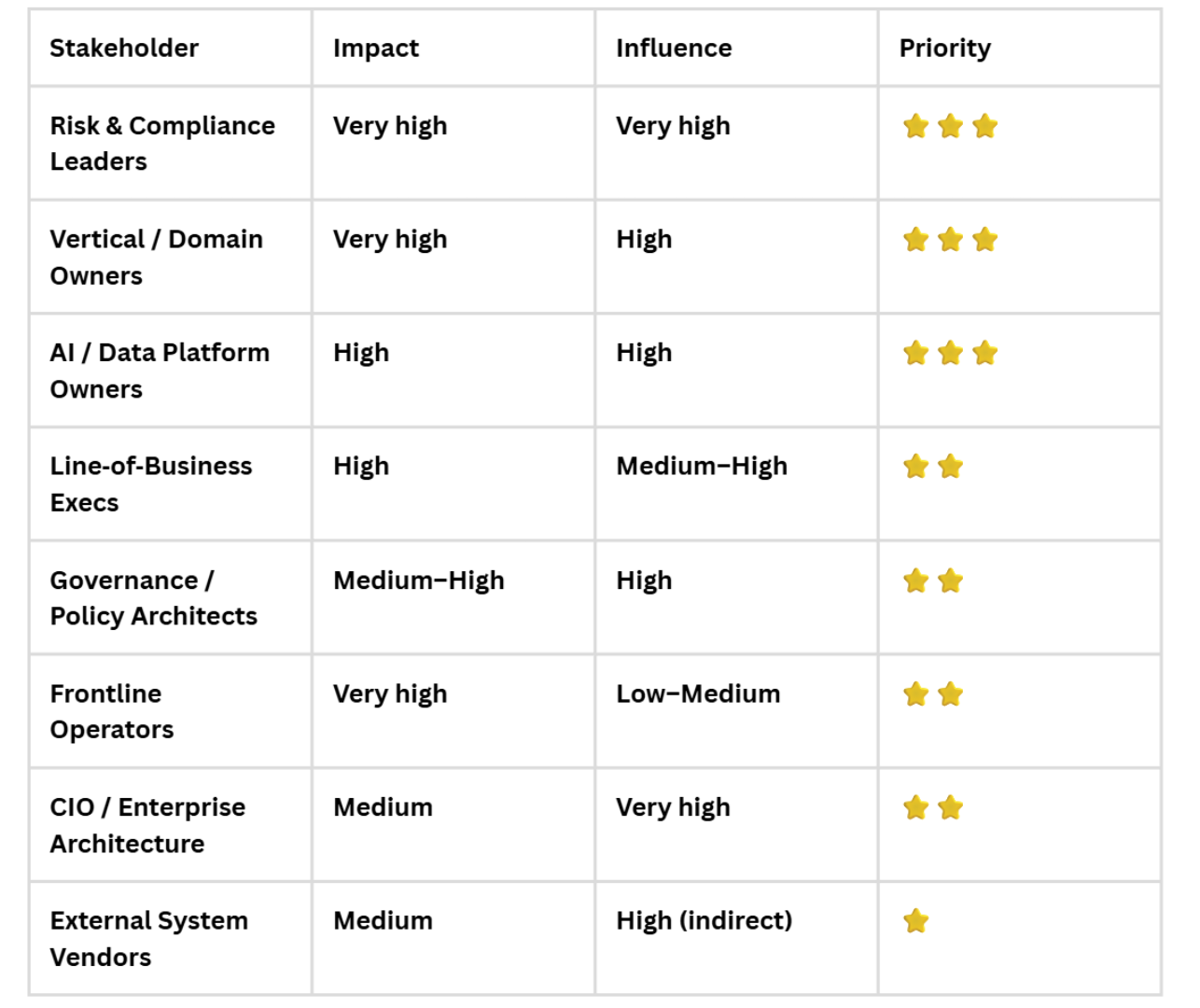
A pattern emerged:
Many roles suffer from truth collisions.
Many roles have partial influence over their domain.
But only one role sits at the intersection of high impact and high influence across all systems.
Only one role inherits every contradiction.
Only one role must make all truths computable at once.
Only one role is responsible for stabilizing the enterprise when reality fragments.
The AI / Data Platform Owner.
Everyone else feels the pain.
Only they inherit the fracture.
The Insight I Didn’t Expect to Find
I evaluated fifteen orchestration‑layer failure modes using six criteria:
Severity — how badly it breaks workflows
Dependency Impact — how many systems it touches
Supplier Concentration — how many external systems constrain it
Time Sensitivity — how fast the failure propagates
Scalability Potential — how much it amplifies under load
Strategic Leverage — how much solving it unlocks downstream value
Across all fifteen, asymmetric authority ranked #2 — not because it is loud, but because it is structural.
It is the invisible fracture beneath every workflow, every integration, every AI action.
And the AI Platform Owner is the only persona who sits directly on top of it.
The AI Platform Owner’s Reality: Truth Collisions Everywhere
If you want to understand asymmetric authority, follow the AI Platform Owner for one week.
Healthcare
The EHR says the patient was discharged.
The workflow system says the case is still open.
The AI model recommends a follow‑up.
The nurse says the discharge was delayed.
Banking
The core banking system marks a transaction as settled.
The fraud engine flags it as suspicious.
The mobile app shows it as pending.
The call‑center agent manually reverses it.
Logistics
The TMS says the truck departed.
The warehouse system says it’s still loading.
The routing AI reroutes based on predicted delays.
The driver radios in: “I haven’t left yet.”
The AI Platform Owner is the only person who must make all of these contradictory truths computable at once.
They don’t choose the truth.
They inherit the fracture.
Pragmatism Inside the Enterprise: Truth as a Stability Function
Pragmatism rejects the idea of truth as a perfect mirror of reality.
Instead, it treats truth as a tool for action — something that keeps the system from breaking.
The AI Platform Owner sees this more clearly than anyone.
Inside the enterprise, truth is not singular.
It is plural:
Risk needs truth that is defensible.
Domain Owners need truth that is regulated.
AI systems need truth that is computable.
Operators need truth that is workable.
These truths don’t align.
They collide.
And the AI Platform Owner is the one who must encode how the enterprise behaves when that happens.
This is why asymmetric authority is not a data problem —
it’s a philosophical condition.
The Most Misunderstood Role in the Enterprise
Executives think the AI Platform Owner is:
building pipelines
tuning models
improving accuracy
integrating systems
But their real job is far more fundamental:
They architect how the enterprise behaves when reality is fragmented.
They design:
dual‑truth reasoning
arbitration logic
continuity stabilization
constraint‑aware orchestration
domain‑safe workflows
defensible decision paths
They are not optimizing AI.
They are stabilizing truth.
They are the architects of survivable contradictions.
Why AI Fails in Enterprises
AI doesn’t hallucinate because it’s broken.
AI hallucinates because the enterprise itself is contradictory.
When systems disagree:
AI has no rule for which truth to follow.
Workflows drift out of domain constraints.
Compliance shuts down automation.
Operators create shadow authority.
Context collapses.
Predictions become incoherent.
AI is simply the first system honest enough to reveal the contradictions.
The AI Platform Owner sees this every day.
The Real Lesson: Architect Truth That Doesn’t Break the System
The future of enterprise AI isn’t about:
better models
cleaner data
tighter integration
more dashboards
It’s about authority architecture — designing how the enterprise behaves when systems disagree about reality.
This is Pragmatism applied to enterprise systems:
Truth is whatever keeps the enterprise stable when reality is fragmented.
Not perfect truth.
Not unified truth.
Not abstract truth.
Survivable truth.
And the AI Platform Owner is the person responsible for making that truth real.
Closing Reflection
We live in a world obsessed with accuracy.
But accuracy is brittle in environments where truth is plural.
Enterprises don’t need perfect truth.
They need truth that doesn’t break the system.
The AI Platform Owner sees this clearly because they live inside the fracture.
They inherit every contradiction.
They encode every compromise.
They stabilize every collision.
This is the philosophy of asymmetric authority.
This is the architecture of survivable contradictions.
This is the discipline enterprises haven’t named —
and the one they need most.